Fewer decisions, short movement breaks: a pilot for students and researchers
A ready-to-run pilot of the ZeroFit app for a Bachelor's or Master's thesis in sport science, psychology or public health. It looks at two things: removing the decisions that stand between a person and a workout, and making short movement breaks easy to take in a working day. The app, the data collection and the support come from us. The research questions can be your own.
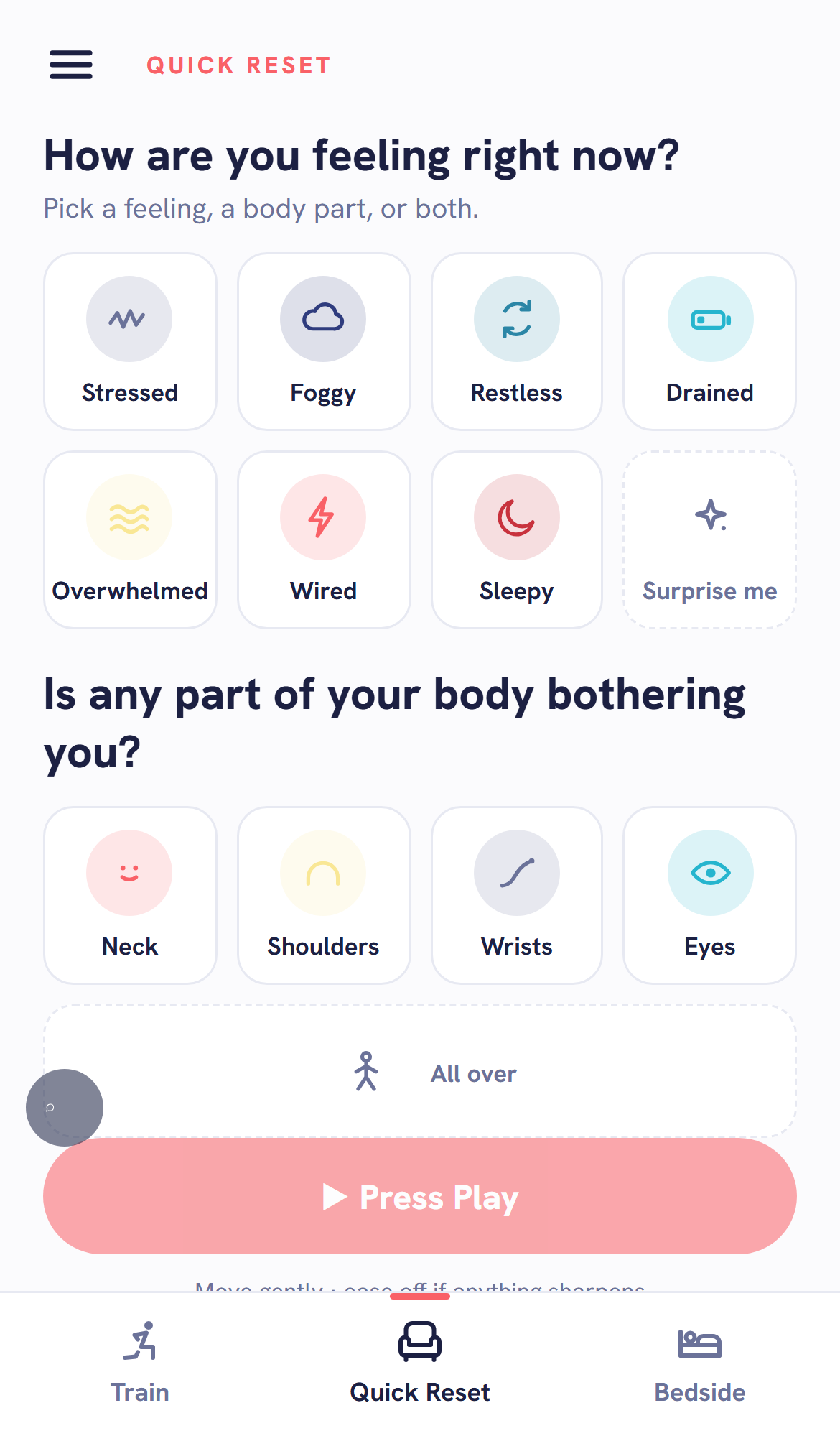
The app, as it works today
A workout without decisions
Users choose their time (5 to 60 minutes) and rate their energy on a five-step scale. With their fitness level, this sets the dose: exercises, sets, repetitions, rest and intensity. A low-energy day still gets a small session.
A break at the desk
Users pick how they feel (for example stressed, foggy or sleepy) or a part of the body that bothers them (neck, shoulders, wrists). They get seated guided stretches of up to five minutes, and the app asks afterwards: better, same or worse?
Movement in bed
Gentle guided movements to do in bed, as an alternative to scrolling before sleep.
Around 1,000 guided video exercises: strength, cardio, mobility, stretching and yoga. Pain areas declared in the profile remove exercises that would load them. No streaks or daily targets. Runs in the phone browser, nothing to install. Currently in closed beta.
Why the app removes decisions
About half of the people who intend to be physically active do not manage it: 47.6% in one meta-analysis [1]. One plausible reason is that starting means deciding what to do, for how long and how hard. ZeroFit takes those decisions away. Here is what the research says about that idea, and where it is still debated.
Choosing takes effort
A large set of options can put people off choosing at all. A meta-analysis of 50 experiments found that, on average, the effect is close to zero. It appeared in some studies and not in others, and no single condition was enough to predict it [2]. A later review found that it grows with how complex and difficult the choice is, and with how unsure people are of what they want [3].
Whether willpower runs out is debated
The usual story of decision fatigue is that making choices uses up a limited store of self-control, so later choices and efforts get worse. Early lab studies reported this [4]. A preregistered replication across 23 laboratories and 2,141 participants found an effect close to zero [5]. The question is still open, so this page does not claim that willpower is a tank that empties.
What the app does about it
You do not browse a library to start. In Train, you give your time and your energy, and the app chooses the exercises, sets, repetitions and rest. In Quick Reset, you tap how you feel or where it bothers, or tap Surprise me, and the app chooses the stretches. Nothing to plan, compare or schedule.
Sources [1] to [5] are listed under Additional reading, at the end of the page.
Train is where the app takes decisions away, so these questions look at use and at starting. The supervising group chooses what is studied and logged.
- Do people start and finish Train sessions, and how often per week?
- Do they find it easy to start? (a System Usability Scale rating)
- Does having no choices to make at the start change how often people begin a session? This could be compared with a version that adds a choice step.
Why short breaks need a proper study
Long sitting at desks, benches and in lectures is common, and short movement breaks are an obvious answer. The evidence is thin. A 2025 Cochrane review rated the evidence on additional work breaks as very uncertain, and none of the included studies looked at how long a break should be [6]. Daily-life experiments suggest that breaks of only three minutes may lift mood and energy [7].
What is not known is whether people take short guided breaks on their own, and which dose and type of break helps.
[6] Luger et al., 2025. Cochrane review of additional work breaks.
[7] Giurgiu et al., 2024. Three-minute breaks in daily life.
Both are listed under Additional reading, at the end of the page.
Quick Reset is the short break, so these questions look at taking breaks and at how people feel afterwards. The supervising group chooses what is studied and logged.
- Do people take short guided breaks on their own, and how often?
- After a Quick Reset, do they feel better, the same or worse? (the app asks this at the end of each break)
- Which kind of break helps: by length, by how the person feels (for example stressed or foggy), or by body area (neck, shoulders)?
The Decision-Fatigue Theory of Why You Don't Work Out
5 min read. Why the deciding gets in the way of the workout, and three ways to design it out of your day.
One way to run the pilot
Design, measures and app modes are chosen with the supervising group. This is a starting point.
| Participants | 25 to 50 students and researchers, voluntary |
|---|---|
| Duration | 8 weeks of use, plus baseline and follow-up |
| App modes | Train and Quick Reset; Bedside optional |
| Setup | Phone browser, nothing to install; a short introduction for participants |
| Design | Chosen with the supervising group, from a single-group before-and-after study to a waitlist control or A/B comparison |
| Cost | None for the university or the participants |
| Data | Pseudonymised, exported for the student's analysis |
Possible measures
Example hypotheses
Most participants keep using the app and rate it as easy and helpful. After a Quick Reset they feel better more often than worse. Stress, well-being and neck or shoulder complaints improve slightly over the eight weeks.
Timeline
Make it fit your research focus
The pilot is built around your research questions. If your group studies something specific, we adapt the study version of the app to it.
Your research questions
Aims and hypotheses from your group's focus can be added, for example break dose, break type, timing, or mood and stress in daily life.
A study version of the app
Questionnaires, before-and-after ratings and usage logs are collected inside the app, so the student does not collect data separately.
Comparisons inside the app
Where the design needs them, for example two break lengths or two types of break.
A data export
Timestamped, with a codebook, ready for analysis.
- Study arms. Any feature can be switched on or off per person, so one arm can run without Quick Reset, without sounds, without Bedside, or with a different range of session lengths. Arms are labelled on the account, and participants join through the normal link.
- Wording and questions. The readiness states, the time range, the two post-session questions and one extra study question (one tap after a session) are small changes, set per arm. So is a consent screen at sign-up for a study arm.
- What is already recorded. Every app open, screen, session, move shown and done, rest pause, skip and post-session answer is logged per account with a timestamp. Adherence, retention, session length, time of day and feature use need nothing new.
- What the supervising group gets. A pseudonymised export per arm at agreed intervals, and the live beta dashboard on request. No raw email addresses leave us.
- What cannot be adapted. Wearables and mood-after measures, custom exercise videos (the clips are MuscleWiki's, streamed under their terms), offline use, and a native app: ZeroFit runs in the browser on iOS and iPadOS 15.4 or later, current Android and desktop browsers. A new mode or a new session logic is not something we promise.
A flag, a question or a wording change takes about a day and ships like any other release.
Students and professors, one way in

Interested in this thesis?
Samana Upadhyaya, co-founder · samana@thezerofit.com
Interested in trying out the app?
Supported by hei_INNOVATION, Heidelberg University's start-up and technology transfer office.
Additional reading
The papers cited above, in the order they appear, then two further reads. Every entry carries a DOI.
- Feil K, Fritsch J, Rhodes RE (2023). The intention-behaviour gap in physical activity: a systematic review and meta-analysis of the action control framework. Br J Sports Med 57(19):1265-1271. doi.org/10.1136/bjsports-2022-106640
- Scheibehenne B, Greifeneder R, Todd PM (2010). Can there ever be too many options? A meta-analytic review of choice overload. J Consum Res 37(3):409-425. doi.org/10.1086/651235
- Chernev A, Böckenholt U, Goodman J (2015). Choice overload: a conceptual review and meta-analysis. J Consum Psychol 25(2):333-358. doi.org/10.1016/j.jcps.2014.08.002
- Vohs KD, Baumeister RF, Schmeichel BJ, Twenge JM, Nelson NM, Tice DM (2008). Making choices impairs subsequent self-control. J Pers Soc Psychol 94(5):883-898. doi.org/10.1037/0022-3514.94.5.883
- Hagger MS, Chatzisarantis NLD, et al. (2016). A multilab preregistered replication of the ego-depletion effect. Perspect Psychol Sci 11(4):546-573. doi.org/10.1177/1745691616652873
- Luger T, et al. (2025). Cochrane review CD012886.pub3. doi.org/10.1002/14651858.CD012886.pub3
- Giurgiu M, et al. (2024). Causal effects of sedentary breaks on affective and cognitive parameters in daily life: a within-person encouragement design. npj Ment Health Res 3:64. doi.org/10.1038/s44184-024-00113-7
- Nakphet N, Chaikumarn M, Janwantanakul P (2014). Effect of different types of rest-break interventions on neck and shoulder muscle activity, perceived discomfort and productivity in symptomatic VDU operators: a randomized controlled trial. Int J Occup Saf Ergon 20(2):339-353. doi.org/10.1080/10803548.2014.11077048
- Chen J, Lu Y, Zhao H, Liu H, Yao J (2025). The effectiveness of exercise snacks as a time-efficient treatment for improving cardiometabolic health in adults: a systematic review and meta-analysis. Front Cardiovasc Med. doi.org/10.3389/fcvm.2025.1643153